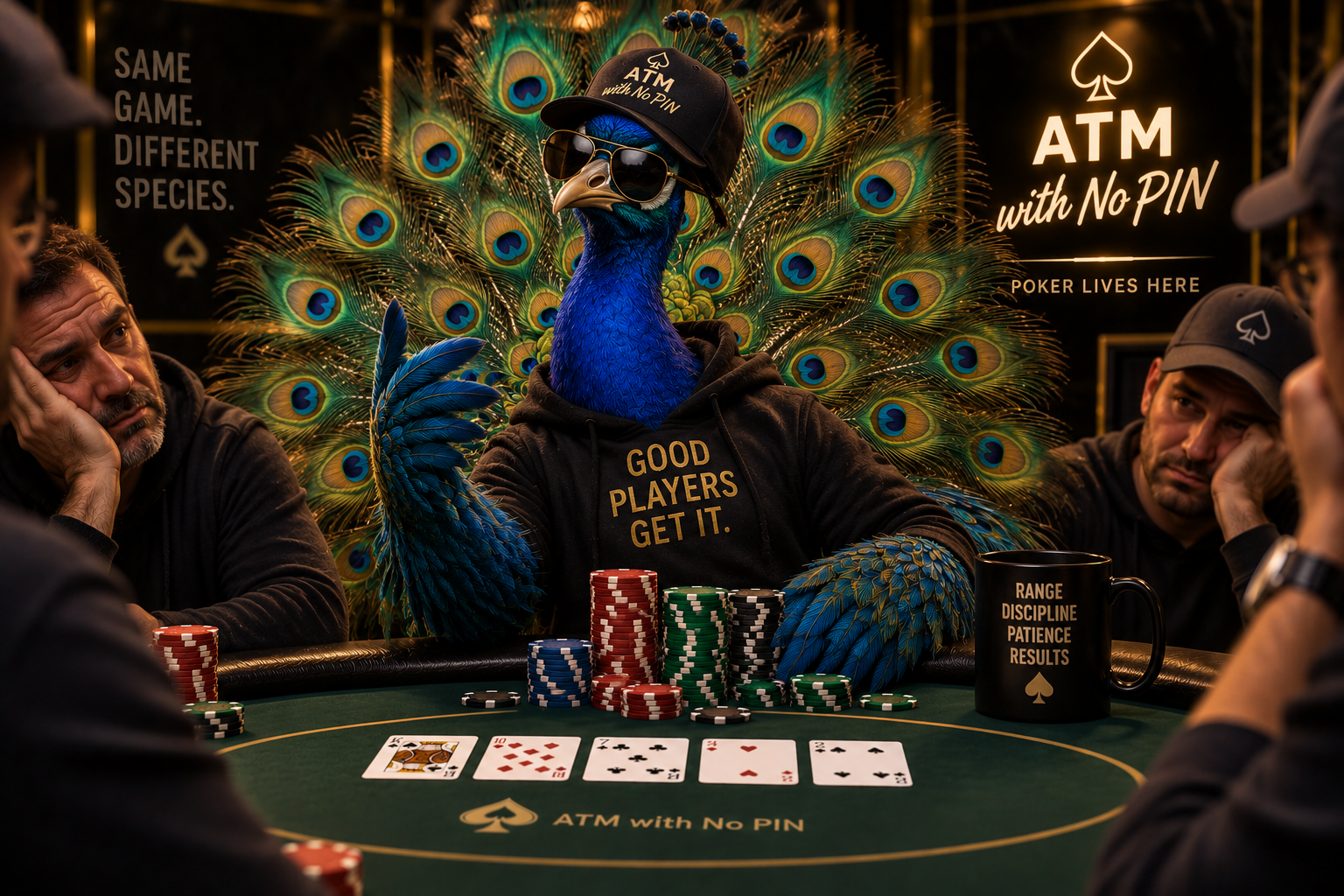
Winning the pot is nice. Making sure everyone understands how brilliantly it was won is better. The Peacock doesn't just play poker. He provides his own highlight reel.
The Peacock at the Poker Table
Every poker room has one.
Not the shark.
Not the whale.
Not the player who quietly knows he's good.
This is a considerably more visible species.
The Peacock.
The Peacock does not simply play poker.
He performs poker.
Every raise has a purpose.
Every fold demonstrates discipline.
Every call reveals advanced understanding.
And every winning hand provides another opportunity to explain just how many levels ahead he was thinking.
The Peacock's greatest fear is not losing a pot.
It's playing one brilliantly and having nobody notice.
A Typical Hand
The Peacock raises.
Another player calls.
Flop.
Peacock bets.
Call.
Turn.
Check.
Check.
River.
The opponent bets.
The Peacock thinks.
Calls.
Opponent turns over a bluff.
Peacock shows the winner.
The dealer pushes him the pot.
For most species, the hand is now over.
Not for the Peacock.
He turns slightly toward the table.
“I knew you didn't have it.”
Nobody challenges this.
Unfortunately, that encourages him.
“Your turn sizing gave it away.”
The opponent says nothing.
“When you checked back the flop earlier with top pair, I knew your range was different here.”
Someone is already shuffling chips for the next hand.
The Peacock continues.
“I almost raised the river.”
Of course he did.
His Greatest Weapon: The Explanation
The Peacock understands an important truth.
Playing a hand well is good.
Explaining afterward that you played it well is even better.
Anyone can win a pot.
But can everyone explain the blocker implications?
The range advantage?
The polarized river sizing?
The exact moment they knew the opponent was weak?
Probably.
But the Peacock got there first.
Even folding becomes an opportunity.
He looks at his cards.
Faces a large river bet.
Folds.
Then announces:
“Good bet. I was actually very high in my range there.”
The dealer collects the cards.
The Peacock nods.
Another masterclass has concluded.
When the Peacock Loses
This is where the species becomes particularly fascinating.
You might think losing a pot would interfere with the Peacock's ability to demonstrate superior poker knowledge.
It does not.
The Peacock has evolved.
If he makes a good call and wins:
Great read.
If he makes a good call and loses:
Correct call mathematically.
If he bluffs and gets a fold:
Perfect spot.
If he bluffs and gets called:
Interesting call by him.
If he folds the winner:
Against his range, folding is completely standard.
This means the Peacock can demonstrate excellent poker regardless of where the chips actually go.
Evolution is remarkable.
The Fascinating Mathematics of the Peacock
Poker players normally calculate things like pot odds, implied odds and equity.
The Peacock calculates something else:
Recognition.
Peacock Mathematics works like this:
Good play + nobody notices = incomplete victory.
Good play + explanation = confirmed brilliance.
Bad result + sophisticated explanation = still basically a good play.
There is also an advanced equation:
Simple decision + enough poker terminology = complex decision.
For example:
“I folded because I thought he had it.”
becomes:
“Given the range interaction on that texture, I don't think he has enough natural bluffs.”
Same fold.
Much better feathers.
Warning Signs
You may be sitting with a Peacock if:
- Every winning hand includes a strategic explanation.
- Every losing hand also includes a strategic explanation.
- “Range” is used in conversations where “hand” would have worked.
- The table knows which training sites he uses.
- Nobody asked about blockers, but blockers have been discussed.
- A standard fold is described as “disciplined.”
- He occasionally reveals what he folded so everyone can appreciate it.
- Simple poker decisions somehow require advanced terminology.
- You know his tournament results because he has made sure of it.
That last symptom is highly reliable.
The Most Dangerous Moment
The most dangerous moment occurs when someone at the table asks:
“Are you a professional?”
The Peacock's feathers immediately expand.
“Well...”
This word can last several minutes.
He isn't technically a professional.
But he plays seriously.
He studies.
He has played some bigger games.
He went deep in a tournament once.
He knows several professionals.
He almost played the Main Event last year.
The answer to the original question has become increasingly difficult to locate.
Eventually someone says:
“So... no?”
This is considered hostile behavior in Peacock territory.
What to Do If You Encounter One
First, don't worry.
The Peacock is generally harmless.
In fact, the species can be entertaining.
Poker players enjoy talking strategy.
Studying the game is good.
Thinking deeply about decisions is good.
But if you're the Peacock, remember:
Not every hand requires a seminar.
Sometimes you made a good call.
Sometimes you made a good fold.
Sometimes you got lucky.
Sometimes you made a mistake.
You don't need to defend every decision like you're presenting evidence before the Supreme Court of Poker.
And if someone else plays a hand differently...
you are not legally required to explain what you would have done.
This may feel unnatural at first.
Practice.
The Strange Truth
Here's where the story becomes interesting.
Most poker players have a little Peacock inside them.
We like being right.
We like making great calls.
We like pulling off bluffs.
And yes...
we like when other poker players notice.
There is nothing wrong with being proud of playing well.
The problem begins when appearing good becomes more important than actually getting better.
The best players don't need every decision validated by the table.
They ask harder questions.
Was my reasoning actually correct?
Did I miss something?
Would I make the same decision again?
Could I have played it better?
Sometimes the answer is uncomfortable.
That's useful.
Because poker doesn't award chips for sounding sophisticated.
The dealer doesn't push the pot toward the player who used the most advanced terminology.
The chips go to whoever wins the hand.
And over time, they tend to migrate toward whoever makes better decisions.
Whether anyone notices or not.
And somewhere in a poker room tonight, a player is about to make a perfectly normal river call.
The opponent will show a bluff.
The dealer will push the pot.
Everyone will prepare for the next hand.
Then someone will lean back slightly.
Arrange his chips.
Spread his metaphorical feathers.
And say:
“I knew exactly where I was.”
Of course you did.
Welcome to the poker room.
Please don't compliment the wildlife too much.