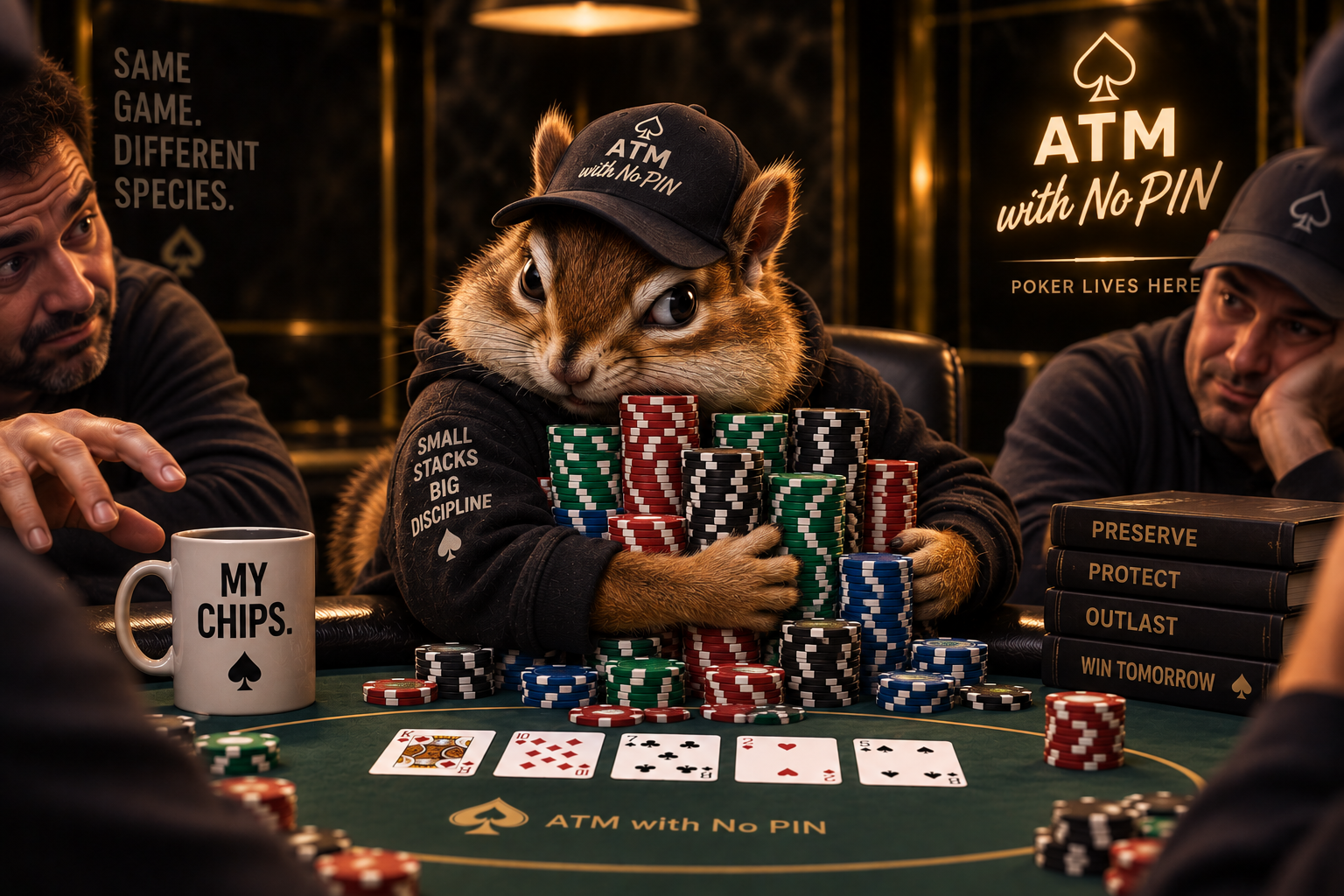
The Chipmunk didn't build that stack just to risk it. Every chip is carefully collected, counted and protected from the dangerous creatures trying to put it into the middle.
The Chipmunk at the Poker Table
Every poker room has one.
Not the shark.
Not the whale.
Not the player who simply understands bankroll management.
This is a considerably more protective species.
The Chipmunk.
The Chipmunk loves poker chips.
Not necessarily betting them.
That would be dangerous.
He prefers collecting them.
Stacking them.
Counting them.
Recounting them.
And most importantly...
keeping them.
To the average poker player, chips are tools used to make bets.
To the Chipmunk, chips are family.
And family must be protected.
A Typical Hand
The Chipmunk looks down at a strong hand.
He raises.
Another player calls.
The flop comes.
Beautiful.
The Chipmunk bets.
Call.
Turn.
Still looking good.
The Chipmunk bets again.
Call.
River.
A completely harmless card appears.
The opponent checks.
The Chipmunk looks at the board.
Then at the opponent.
Then at his chips.
This is where things become complicated.
There is probably another value bet available.
But value betting requires putting chips into the middle.
Those chips are currently safe.
The middle of the table is not safe.
The Chipmunk thinks.
Then checks.
Opponent shows a worse hand.
The Chipmunk proudly turns over the winner.
Someone at the table says:
“You could've bet the river.”
The Chipmunk looks at his stack.
All chips accounted for.
Mission accomplished.
His Greatest Enemy: The Pot
The Chipmunk has a complicated relationship with the pot.
He enjoys winning it.
He simply dislikes contributing to it.
Every chip placed across the betting line experiences an uncertain future.
Will it return?
Will it bring friends?
Or will it disappear permanently into another player's stack?
These are serious questions.
The Whale sees a large pot and thinks:
“This is getting interesting.”
The Chipmunk sees a large pot and thinks:
“Why are all my chips over there?”
Two species.
Same game.
Very different ecosystems.
When the Chipmunk Builds a Stack
This is where the species becomes particularly fascinating.
The Chipmunk wins several pots.
His stack grows.
$500 becomes $800.
$800 becomes $1,200.
$1,200 becomes $1,600.
You might assume that having more chips would make the Chipmunk more comfortable.
It does not.
Now there is considerably more to lose.
The larger the stack becomes, the more valuable its preservation becomes.
Soon the Chipmunk begins looking at the stack the way a museum security guard looks at a priceless painting.
Nobody touch anything.
The Fascinating Mathematics of the Chipmunk
Poker players normally calculate things like pot odds, implied odds and equity.
The Chipmunk calculates:
Chip Preservation Probability.
Chipmunk Mathematics works like this:
Chip in my stack = safe.
Chip in the pot = endangered.
Large bet = many endangered chips.
All-in = ecological catastrophe.
There is also an advanced formula:
Profit already won + additional risk = why would I do that?
This creates an interesting paradox.
The Chipmunk came to the poker room to win chips.
Once he wins them...
he becomes increasingly reluctant to play poker with them.
Warning Signs
You may be sitting with a Chipmunk if:
- His chip stacks are unusually neat.
- He knows almost exactly how much he is up.
- He recounts his stack after every significant pot.
- Thin value bets cause visible discomfort.
- Large pots are approached like unexploded devices.
- He becomes noticeably tighter after winning.
- A player reaching toward his stack for change receives immediate supervision.
- He says “I'm up pretty good” while looking toward the exit.
- His biggest concern after doubling up is protecting the double-up.
That last symptom is highly diagnostic.
The Most Dangerous Moment
The most dangerous moment occurs when the Chipmunk reaches a personal profit milestone.
Maybe he bought in for $500.
Now he has $1,000.
A beautiful number.
Exactly double.
The Chipmunk looks at the stack.
Then at the clock.
Then back at the stack.
A decision has been made.
He will play exactly one more orbit.
Experienced Poker Wildlife observers recognize the danger immediately.
Because the Chipmunk is no longer trying to win.
He is trying desperately not to lose the number $1,000.
Every hand now represents a threat.
Ace-jack?
Dangerous.
Pocket eights?
Potentially expensive.
Suited connectors?
Absolutely not.
The Chipmunk has entered full winter-storage mode.
What to Do If You Encounter One
First, don't confuse caution with weakness.
Protecting your stack can be smart.
Avoiding unnecessary risks can be smart.
Bankroll discipline is extremely smart.
But chips at the poker table are not collectibles.
They are tools.
Sometimes the correct decision requires betting them.
Sometimes the correct decision requires calling with them.
Sometimes the correct value bet will lose.
That's poker.
If you're the Chipmunk, ask yourself a useful question:
“Would I make the same decision if I had just sat down with this stack?”
If the answer is different simply because you're protecting today's profit...
the wildlife may be influencing the strategy.
The Strange Truth
Here's where the story becomes interesting.
Most poker players have a little Chipmunk inside them.
Losing money hurts.
But losing money we already feel we've won can hurt even more.
Start with $500 and fall to $300?
Bad.
Start with $500, run it up to $1,500 and fall back to $1,000?
Somehow that can feel worse.
Even though you're still up $500.
Poker does strange things to the human brain.
We mentally claim chips before we've left the table.
We create imaginary high-water marks.
Then we begin protecting those numbers instead of making good decisions.
The best players understand something uncomfortable:
The chips don't know when you won them.
A $25 chip you brought from the cage is worth exactly the same as a $25 chip you won five minutes ago.
The decision in front of you is still the decision in front of you.
And somewhere in a poker room tonight, a player is about to win a big pot.
He'll stack the chips.
Count them.
Straighten them.
Count them again.
Then look around the table at all the dangerous creatures who apparently want to take them.
He'll pull the stacks slightly closer.
Winter could arrive at any moment.
Welcome to the poker room.
Please don't touch the wildlife's chips.