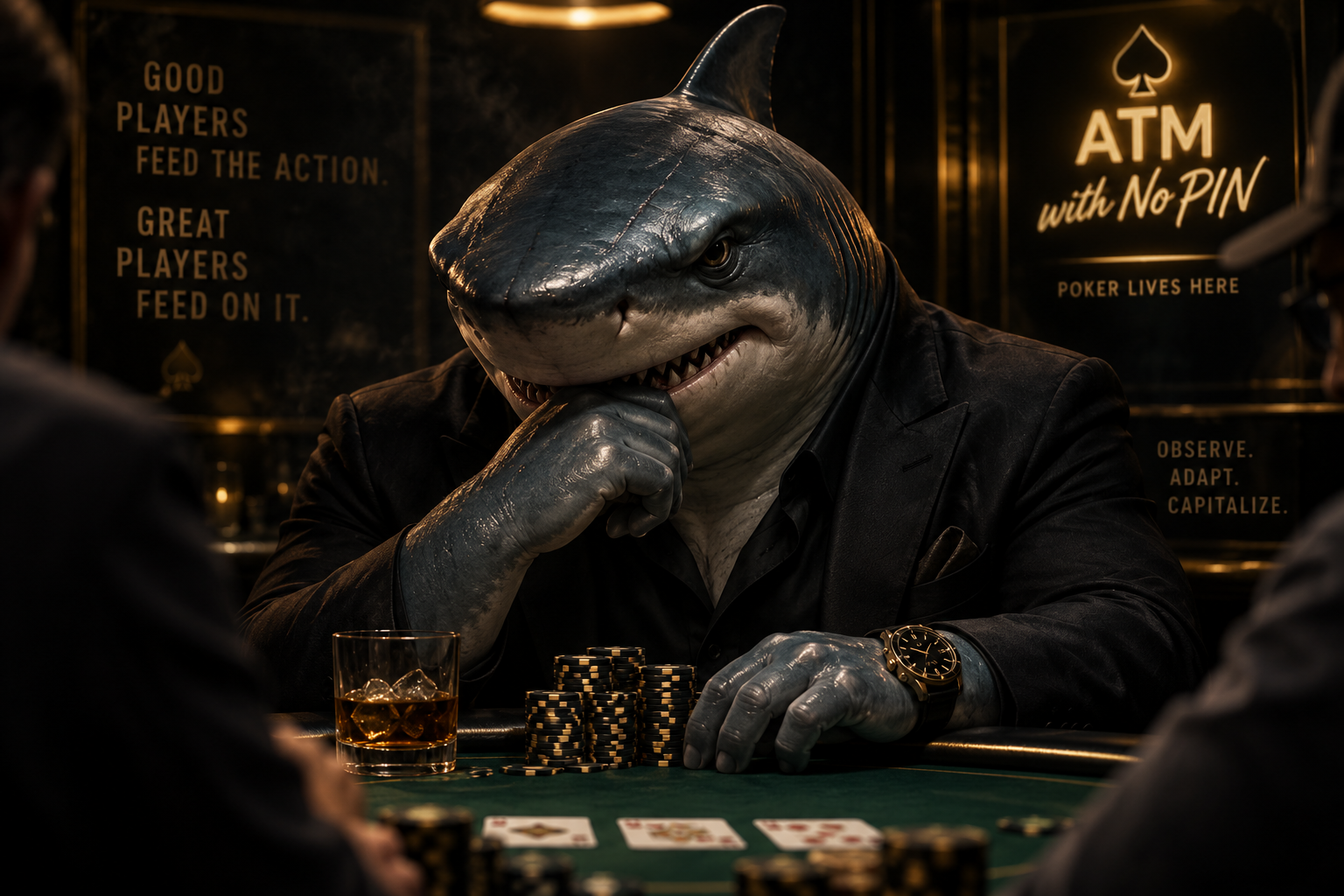
Quiet, patient and always watching. The Shark doesn't need to dominate the conversation. He's too busy figuring out who at the table is about to donate a stack.
The Shark at the Poker Table
Every poker room has one.
Not the loudest player.
Not the player explaining ranges to everyone.
Not the guy telling you about the tournament he almost won.
This is a quieter species.
The Shark.
You usually don't notice the Shark when he first sits down.
That's part of the problem.
He buys his chips.
Takes his seat.
Says hello.
And starts watching.
While everyone else is talking about sports, bad beats, dinner plans and whether somebody should have called the river, the Shark is gathering information.
Within an orbit, he knows who hates folding.
He knows who raises only when they have it.
He knows who can't resist defending the big blind.
He knows who talks constantly until they suddenly have a big hand.
He knows who is tired.
He knows who is frustrated.
And unfortunately...
he has started learning things about you too.
A Typical Hand
The Shark folds.
Then folds again.
Then calls once.
Then folds.
Nothing particularly interesting appears to be happening.
Twenty minutes later, a player who has been raising too many hands opens again.
The Shark calls.
The flop comes.
The player bets.
Shark calls.
Turn.
Another bet.
Another call.
River.
The player fires one more time.
The Shark sits quietly.
No speech.
No dramatic stare at the dealer.
No five-minute performance.
Call.
The other player reluctantly turns over a bluff.
The Shark turns over the winner.
The dealer pushes him the pot.
The Shark stacks the chips.
That's it.
No explanation.
No lecture.
No:
“I knew you were bluffing.”
But he did.
And that's considerably more annoying.
His Greatest Weapon: Attention
Most players think poker is about cards.
The Shark understands that poker is also about people.
While you're looking at your phone, he's watching the table.
While you're telling a bad-beat story, he's listening to how you describe hands.
While you're complaining about the player in Seat 4, he's learning something about both of you.
The Shark notices patterns.
Bet sizing.
Timing.
Position.
Tilt.
Fear.
Confidence.
And the moment somebody announces:
“I'm only playing one more orbit.”
The Shark becomes particularly interested.
That sentence frequently means:
“I would like to make one final questionable decision before leaving.”
The Shark respects tradition.
When the Shark Loses
This is where the species becomes fascinating.
The Shark can lose a pot.
Sometimes a very large pot.
A two-outer hits.
A bluff gets called.
A draw misses.
The dealer pushes the chips somewhere else.
And then something extraordinary happens.
The Shark...
doesn't hold an investigation.
He may think about the hand.
He may replay the decision.
He may decide he made a mistake.
Or he may decide he played it correctly and variance did what variance does.
Then he waits for the next hand.
This behavior is extremely confusing to certain other Poker Wildlife species.
The Fascinating Mathematics of the Shark
Poker players normally calculate things like pot odds, implied odds and equity.
The Shark adds another variable:
You.
Shark Mathematics looks something like this:
Good cards + good situation = play.
Good cards + bad situation = think.
Bad cards + bad situation = fold.
Opponent emotionally unraveling = pay attention.
There is another important equation:
Small mistakes avoided repeatedly = a lot of chips eventually.
The Shark doesn't need to win every pot.
He just needs to be paying attention when somebody decides to lose a very large one.
Warning Signs
You may be sitting with a Shark if:
- He says very little but seems to know what's happening.
- He remembers a hand you played two hours ago.
- He doesn't appear emotionally attached to folding.
- His bets seem annoyingly well timed.
- He becomes more attentive when somebody starts tilting.
- He rarely ends up in a giant pot by accident.
- He asks innocent questions that somehow reveal useful information.
- You suddenly realize he has position on you again.
- Your stack is getting smaller and you're not entirely sure when it happened.
That last symptom deserves immediate attention.
The Most Dangerous Moment
The Shark's favorite moment is not necessarily when he has aces.
It's when another player stops playing poker and starts playing emotionally.
Maybe someone just lost a huge pot.
Maybe they're trying to get even.
Maybe somebody embarrassed them with a bluff.
Maybe they've announced:
“I'm getting my chips back from this guy.”
To most people, this sounds like frustration.
To the Shark, it sounds like a dinner bell.
The Shark doesn't need to create the mistake.
He just needs to be there when it happens.
What to Do If You Encounter One
Do not panic.
Do not suddenly try to prove that you're the better player.
Do not manufacture a giant bluff because you want to “send a message.”
The Shark does not require messages.
He prefers chips.
Play your game.
Pay attention.
Choose your spots.
Think before building enormous pots.
And remember that folding is considerably cheaper than demonstrating courage.
Most importantly, don't assume that because the Shark is quiet, he isn't doing anything.
He's doing plenty.
You're just not invited to the meeting.
The Strange Truth
Here's where the story becomes interesting.
Poker players love identifying Sharks.
Usually other people.
But the qualities that make the Shark dangerous aren't mysterious.
Patience.
Observation.
Discipline.
Emotional control.
Selective aggression.
The ability to fold.
The willingness to admit when a decision was wrong.
None of these are particularly glamorous.
That's probably why they're so effective.
The Shark doesn't win every hand.
Nobody does.
He simply understands that poker is a long sequence of small decisions interrupted occasionally by very expensive mistakes.
His objective is simple:
Make fewer of those mistakes than you do.
And somewhere in a poker room tonight, someone is talking.
Someone is tilting.
Someone is trying desperately to win their money back.
Someone else is quietly watching.
You may not have noticed him yet.
That's okay.
He noticed you.
Welcome to the poker room.
Please don't feed the wildlife.