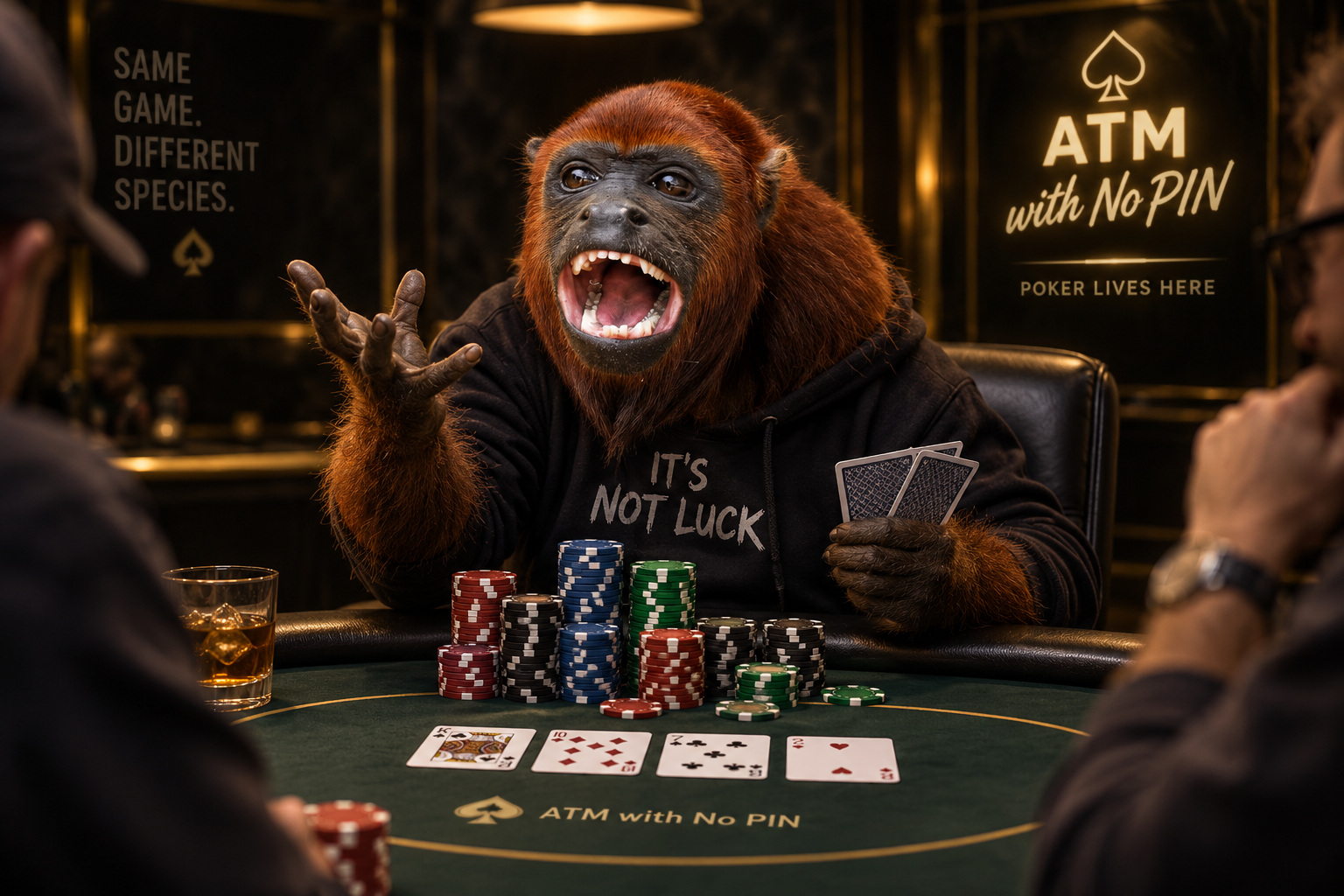
Loud, emotional and permanently one bad beat away from launching a full investigation. The Howler Monkey believes every pot he wins is skill, while every pot he loses requires an explanation.
The Howler Monkey at the Poker Table
Every poker room has one.
Not the shark.
Not the whale.
Not the nit.
This is a different species entirely.
The Howler Monkey.
You usually hear him before you notice him.
The Howler Monkey is an interesting creature because, according to him, he has never actually lost a poker hand.
Other people have simply caused him to lose.
If his aces get cracked, the dealer shuffled badly.
If someone calls his raise with 8♠ 6♠ and makes a straight, the player is an idiot.
If he bluffs the river and gets called, the opponent clearly has no idea how poker is supposed to be played.
If he folds and would have made the winning hand?
Naturally, the dealer put the cards out incorrectly.
There is always an explanation.
And remarkably, that explanation never involves the Howler Monkey.
A Typical Hand
The Howler Monkey raises.
Another player calls.
The flop comes.
Howler bets.
Call.
The turn comes.
Howler bets bigger.
Call.
The river completes a draw.
The other player bets.
Howler stares at him.
Then at the board.
Then at the dealer.
Then back at the player.
Finally, he calls.
The other player turns over the winner.
Silence.
For approximately 1.7 seconds.
Then the wildlife documentary begins.
“HOW CAN YOU CALL THE FLOP WITH THAT?”
The opponent quietly stacks the chips.
The dealer prepares for the next hand.
But our Howler Monkey isn't finished.
Not even close.
He now reconstructs the entire hand for everyone at the table, including three people who weren't paying attention and one person wearing headphones.
Every street must be reviewed.
Every bet must be analyzed.
Every decision made by his opponent must be presented to the jury.
“You understand how bad that call was?”
Nobody answers.
This is interpreted as agreement.
His Greatest Enemy: The Dealer
Dealers have an extraordinary amount of power in the Howler Monkey universe.
They can apparently control the deck.
They can summon river cards.
They can make opponents call.
Sometimes they even seem capable of changing mathematical probability itself.
A dealer pushes him a $900 pot?
Perfectly normal.
Excellent dealing.
Professional operation.
Same dealer gives someone else a two-outer on the river?
Suspicious.
Very suspicious.
The Howler looks at the dealer.
Then the river.
Then the dealer again.
No accusation needs to be made.
The investigation has already begun.
When the Howler Wins
This is where the species becomes particularly fascinating.
When the Howler Monkey wins a big pot, the entire poker universe suddenly begins functioning normally again.
The dealer is competent.
The cards are fair.
The opponent's questionable call is simply part of poker.
Variance exists.
Mathematics works.
The Howler calmly stacks his chips.
There is no investigation.
There is no demand to review how the opponent could possibly have called the flop.
Instead, you may hear something like:
“I knew exactly where I was.”
Of course he did.
The Fascinating Mathematics of the Howler Monkey
Poker players normally calculate things like pot odds, implied odds and equity.
The Howler Monkey uses a different formula:
If I win = skill.
If you win = luck.
There are several advanced variations:
If I make a questionable call and win = great read.
If you make a questionable call and win = terrible player.
If I hit the river = that's poker.
If you hit the river = unbelievable.
This system has one major advantage.
It produces the same answer regardless of the cards.
Warning Signs
You may be sitting with a Howler Monkey if:
- Every bad beat requires a speech.
- Opponents are regularly asked to explain why they called.
- Dealers receive unsolicited performance reviews.
- Winning pots are remembered as skill.
- Losing pots are remembered as injustice.
- A perfectly ordinary river card becomes a personal attack.
- “Unbelievable” is used several times per orbit.
- The entire table knows about a hand that happened three hours ago.
- He has announced that he is leaving more than once.
That last symptom is particularly important.
The Most Dangerous Moment
Eventually the Howler Monkey reaches his emotional limit.
He pushes back from the table.
He shakes his head.
He looks at the dealer.
He looks at the player who just beat him.
Then comes the announcement:
“I'M DONE.”
He begins racking up his remaining chips.
Everyone assumes the documentary has concluded.
But experienced poker players know better.
There is an excellent chance he will sit there for another orbit.
Possibly two.
Because leaving now would allow the universe to get away with what it has done to him.
And justice must be served.
One more hand.
Then another.
Perhaps the cards will finally apologize.
What to Do If You Encounter One
Remain calm.
Do not attempt to solve the investigation.
Do not explain variance.
Do not present equity calculations.
Do not remind him that everyone gets bad beats.
And under absolutely no circumstances should you say:
“But you called with something similar earlier.”
This may trigger a secondary investigation.
The safest response is usually:
“That's poker.”
Then allow the ecosystem to stabilize naturally.
The Strange Truth
Here's where the story becomes interesting.
Most poker players have a little Howler Monkey inside them.
We remember the two-outer that destroyed us much longer than the two-outer that saved us.
We notice terrible calls against us while conveniently forgetting our own questionable decisions.
We remember the river card that cost us a huge pot.
The river card that saved us three hours earlier?
Somehow that one doesn't make the documentary.
We blame variance when we lose and congratulate ourselves when we win.
That's human nature.
And poker has an extraordinary ability to expose it.
The difference is that good poker players eventually ask:
“What could I have done differently?”
The Howler Monkey asks:
“Who did this to me?”
That difference matters.
Because poker doesn't care whose fault you think it was.
Sometimes you played perfectly and lost.
Sometimes your opponent played terribly and won.
Sometimes you were the one who played terribly.
The chips don't hold an investigation.
They simply move across the table.
And somewhere in a poker room tonight, a river card is about to fall.
A dealer is about to push a pot.
Someone is about to stare at the board in disbelief.
There will be a brief silence.
Perhaps 1.7 seconds.
And then, from somewhere deep in the poker jungle, you'll hear it:
“HOW CAN YOU CALL WITH THAT?”
Welcome to the poker room.
Please don't feed the wildlife.