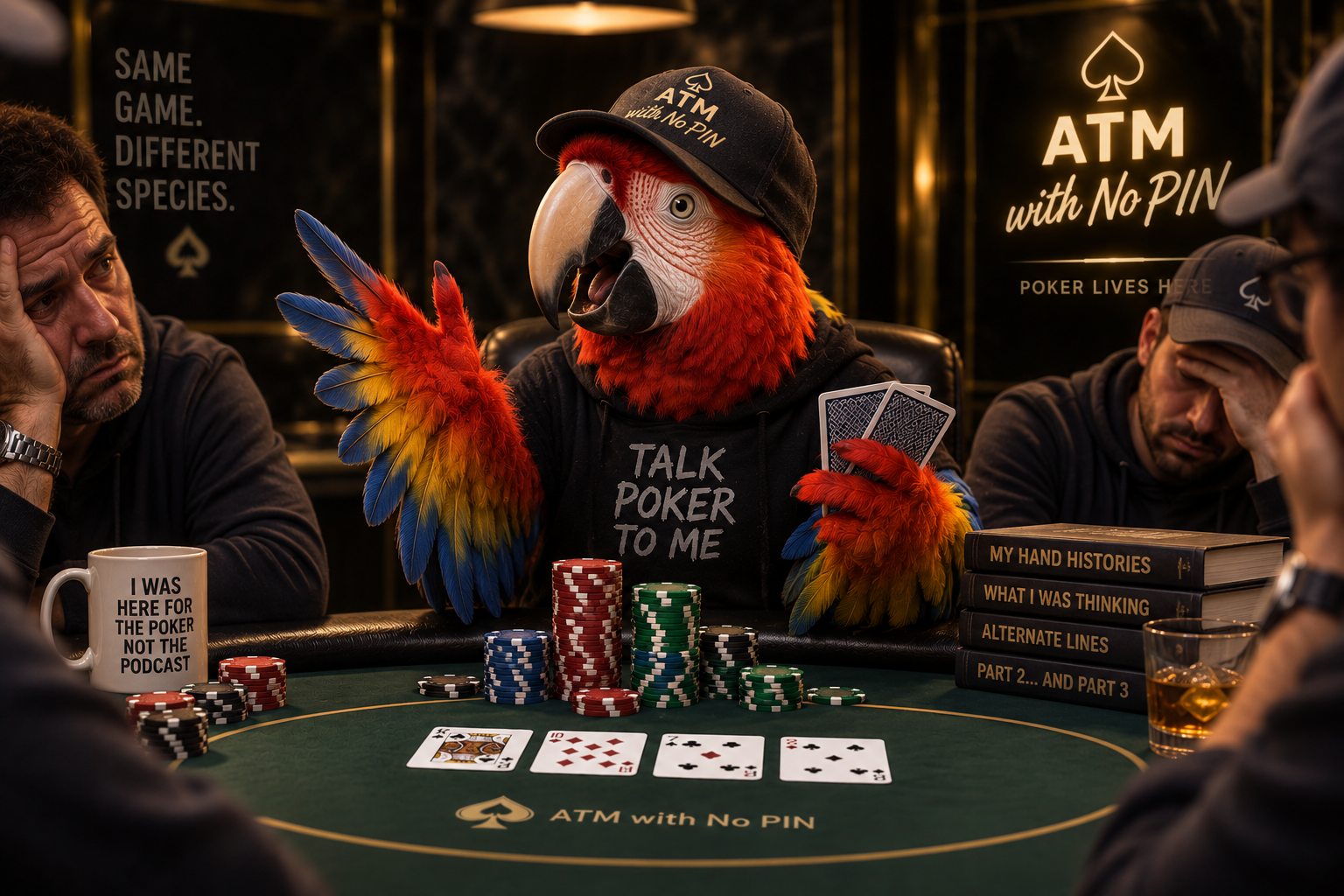
The hand may be over, but the story has just begun. The Parrot will replay every bet, every card and every thought process for anyone within hearing distance, whether they asked or not.
The Parrot at the Poker Table
Every poker room has one.
Not the shark.
Not the whale.
Not the player who occasionally discusses an interesting hand.
This is a considerably more vocal species.
The Parrot.
The Parrot possesses one of the most remarkable memories in the poker ecosystem.
He can remember every detail of a hand.
The preflop raise.
The flop.
The turn.
The river.
The bet sizes.
The stack sizes.
What he was thinking.
What he thought his opponent was thinking.
What he thought his opponent thought he was thinking.
And fortunately for everyone at the table...
he is willing to share all of it.
Repeatedly.
A Typical Hand
The Parrot raises.
Another player calls.
The flop comes.
Bet.
Call.
Turn.
Check.
Check.
River.
The Parrot bets.
Opponent folds.
The dealer pushes him the pot.
The hand is officially over.
But only according to the rules of poker.
According to the Parrot, the hand has just entered its second phase:
The Documentary.
“You know what I had there?”
Nobody answers.
This is not important.
“I had ace-queen.”
A new hand is being dealt.
The Parrot continues.
“When you called me preflop, I put you on a medium pair.”
The player next to him looks at his cards.
Another player folds.
The Parrot continues.
“Then when the flop came king-nine-four...”
Everyone knows what the flop was.
They were there.
But historical accuracy requires reconstruction.
His Greatest Enemy: Silence
Most poker players are comfortable allowing a completed hand to disappear into history.
The Parrot considers this irresponsible.
Important poker knowledge could be lost.
Therefore, every significant hand must be preserved through oral tradition.
Sometimes immediately.
Sometimes ten minutes later.
Sometimes again during dinner.
The Parrot is particularly fond of beginning with:
“Let me tell you what happened in this hand.”
This is often directed toward someone who was sitting at the table when it happened.
They already know.
The Parrot knows they know.
This changes nothing.
The Director's Commentary
The Parrot does not merely describe what happened.
That would be too simple.
He provides commentary.
“When he checked the turn, I knew he didn't have a king.”
Pause.
“So now I'm thinking...”
Another pause.
“If I bet here, what worse hand calls me?”
The dealer is now halfway through the next hand.
The Parrot continues.
“But here's the interesting part.”
There is always an interesting part.
Occasionally there are several.
The story expands.
New strategic considerations emerge.
Alternative timelines are explored.
What if the turn had been a heart?
What if the opponent had raised?
What if stacks were deeper?
What if this happened in a tournament?
Nobody knows.
Nobody asked.
But the Parrot has considered these possibilities.
When Someone Actually Asks About a Hand
This is the Parrot's moment.
Someone makes the innocent mistake of saying:
“What did you have?”
The Parrot's eyes light up.
Permission has been granted.
What the questioner expected:
“Ace-queen.”
What the questioner receives:
“Well, let me start with the preflop action...”
This is an important distinction.
The Parrot does not answer poker questions.
He produces extended editions.
The Fascinating Mathematics of the Parrot
Poker players normally calculate things like pot odds, implied odds and equity.
The Parrot calculates something different:
Story Length.
Parrot Mathematics works like this:
30-second hand = 4-minute explanation.
2-minute hand = 12-minute explanation.
Interesting river decision = potentially unlimited runtime.
There is also an advanced formula:
Someone asks one question + Parrot remembers another hand = entire orbit gone.
Researchers have been unable to establish an upper limit.
Warning Signs
You may be sitting with a Parrot if:
- Every completed hand comes with commentary.
- “So here's what I was thinking...” is heard frequently.
- A new hand begins while the previous hand is still being discussed.
- Bet sizes from three hours ago remain available from memory.
- Someone wearing headphones is still receiving the story.
- The dealer has said “Action is on you” because the Parrot was explaining another hand.
- One poker story somehow becomes three poker stories.
- Dinner breaks include hand histories.
- You know what he folded despite never asking.
That last symptom is considered conclusive.
The Most Dangerous Moment
The most dangerous moment occurs when another player says:
“Yeah, something similar happened to me once.”
Two Parrots may now be active simultaneously.
The first Parrot tells his hand.
The second Parrot responds with another hand.
The first Parrot remembers a third hand.
A comparative analysis begins.
The poker table has now become a podcast.
There is no host.
There are no microphones.
And unfortunately...
there is no pause button.
What to Do If You Encounter One
First, understand that the Parrot usually means well.
Poker is interesting.
Hands are interesting.
Strategy is interesting.
Talking about poker is part of the fun.
But if you're the Parrot...
learn to recognize the difference between a conversation and a hostage situation.
Ask before launching the director's commentary.
Keep the story moving.
Notice whether anyone is actually listening.
And occasionally allow a poker hand to simply...
end.
If you're sitting next to the Parrot, several defensive techniques are available.
Looking at your phone may help.
Headphones provide limited protection.
A bathroom break is highly effective.
But be careful.
When you return, the Parrot may still be on the turn.
The Strange Truth
Here's where the story becomes interesting.
Most poker players have a little Parrot inside them.
We love telling stories about poker.
Especially our poker.
The huge bluff.
The impossible call.
The terrible beat.
The hand where we “just knew.”
Notice something interesting?
Poker players rarely tell ten-minute stories about folding nine-four before the flop.
We remember the dramatic hands because those are the moments that make poker memorable.
And sharing those stories is part of poker culture.
The trick is knowing when people actually want to hear them.
A good poker story makes the table laugh.
A great poker story makes everyone remember it.
A twenty-minute explanation of why you checked the turn...
may accomplish something else.
And somewhere in a poker room tonight, a hand is about to finish.
The dealer will push the pot.
The cards will be collected.
The next hand will begin.
Everyone will move on.
Almost everyone.
From somewhere at the table, a voice will say:
“You know what I had there?”
Nobody will answer quickly enough.
And the documentary will begin.
Welcome to the poker room.
Please don't encourage the wildlife.